How to Choose the Best PU Leather Material for Your Needs?
Choosing the best PU Leather Material requires more than comparing color, texture, and price. The application matters first. Upholstery needs strong abrasion resistance, stable coating adhesion, and easy cleaning. Footwear demands flexibility, fold resistance, and reliable hydrolysis performance. Bags may need a balanced hand feel, tear strength, and edge durability. A glossy showroom sample can hide weak backing fabric or early surface cracking.
Market data shows why this decision deserves care. Grand View Research valued the global synthetic leather market at about USD 31.6 billion in 2022 and projected continued growth through 2030. However, many reports combine polyurethane and PVC products, so their figures cannot describe every PU Leather Material grade. That limitation is easy to miss. Testing still matters more than a headline number. Request abrasion, tensile, flexing, hydrolysis, colorfastness, and volatile organic compound data from the supplier. Check the test method and laboratory, not only the result.
Dr. Richard Blackburn, a sustainable materials specialist at the University of Leeds, has emphasized, “There is no such thing as a sustainable material; there are only more sustainable materials.” His point is practical here. A bio-based coating is not automatically better if it fails quickly or cannot be responsibly managed after use. Ask about polyurethane chemistry, recycled content, solvent systems, backing composition, production controls, and expected service life. Touch the sample. Bend it repeatedly. Inspect the reverse side. The best choice is rarely the cheapest roll. It is the material that performs reliably in its real environment, with evidence strong enough to support the claim.
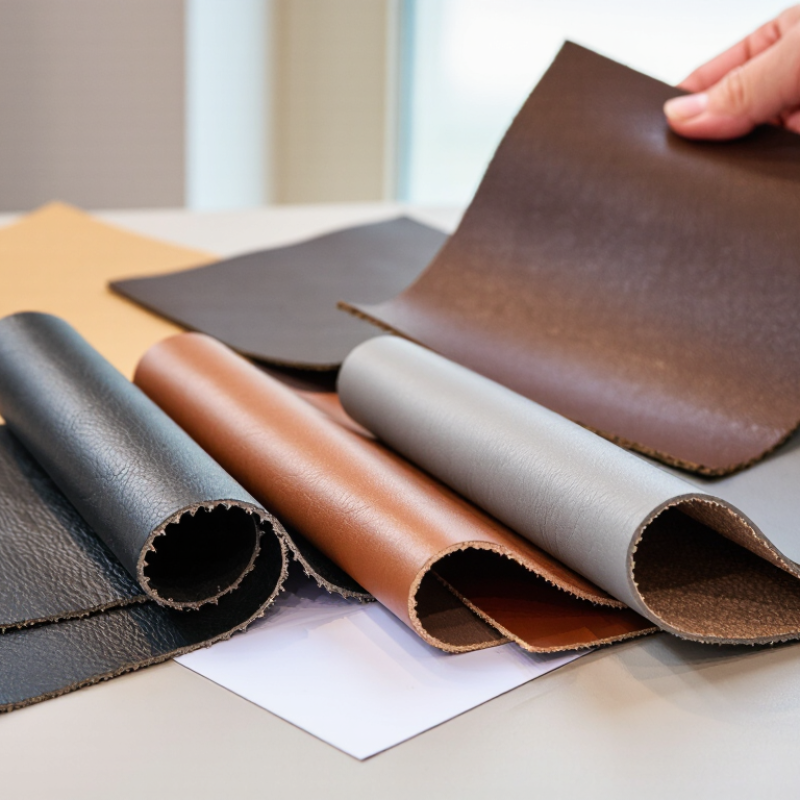
Understanding PU Leather and Its Main Material Types
Choosing the best PU leather starts with understanding its construction. PU leather is a textile backing coated with polyurethane, not a single uniform material. The backing may use polyester, cotton, or microfiber. Polyester-based PU usually offers stronger abrasion and oil resistance. Polyether-based PU often handles moisture and hydrolysis better. Feel matters.
Manufacturers commonly use dry-process, wet-process, or microfiber PU systems. Dry-process PU creates a compact, smooth surface and suits furniture or footwear applications. Wet-process PU forms tiny pores, giving the material a softer, more breathable hand. Microfiber PU has a dense, suede-like backing and can provide better strength, although it often costs more. Textile Exchange’s Materials Market Report 2024 states that polyester represented 59% of global fiber production in 2023. That figure helps explain why polyester-backed PU remains widely available.
Performance data should guide the final choice. Grand View Research’s Synthetic Leather Market Analysis estimates the market exceeded 36 billion US dollars in 2023, showing strong demand across automotive, furniture, and apparel sectors. Yet market growth does not guarantee quality. A glossy sample may hide weak adhesion. Looks deceive. Request tests for abrasion, flexing, hydrolysis, color transfer, and seam strength. Check thickness at several points, because uneven coating can cause early cracking. I still find hand-feel comparisons imperfect; humidity changes the result. Test twice, under dry and damp conditions, before selecting the material for regular use.
Identifying Your Product’s Functional and Aesthetic Requirements
Choosing PU leather starts with the product’s working conditions, not its color. A handbag needs abrasion resistance, flexible backing, and stable edge performance. Upholstery requires softness, cleanability, and resistance to repeated sitting. For footwear, evaluate flex cracking, moisture exposure, and seam behavior. Write these requirements before reviewing samples. Otherwise, attractive grain may distract from practical weaknesses. Keep a simple test record. Include thickness, backing type, surface finish, and odor after opening.
Aesthetic decisions should support use. Fine grain can suit a quiet office chair, while deeper embossing hides minor scuffs on busy furniture. Warm neutrals often look softer under indoor lighting, but colors may shift beside wood, metal, or fabric. Request samples larger than a hand. Small swatches hide pattern scale and uneven coating. View them near a window and under artificial light. This is easy to overlook.
From practical sampling, I would bend, stretch, wipe, and lightly rub every candidate. Check whether the coating feels tacky after cleaning and whether the backing shows through folds. Ask for test data, but do not treat a certificate as the whole answer. Production consistency matters too. Compare samples from different rolls when possible. I once favored a beautiful finish that marked easily during installation. That mistake changed my selection process. Performance and appearance must be judged together, even when the first impression feels convincing.
Comparing Durability, Texture, Breathability, and Maintenance
Choosing PU leather starts with the environment, not appearance. For busy seating, check abrasion results under ISO 12947 or the Wyzenbeek method.
The 2023 Association for Contract Textiles Performance Guidelines commonly reference 15,000 double rubs for general use and 30,000 for heavy use. These figures are useful, but they are not guarantees. Seams, sharp clothing, sunlight, and body oils can shorten service life.
Texture also affects daily comfort. A dense, embossed surface hides minor scratches, while a smooth finish feels more natural but shows marks quickly. Breathability depends on the backing, coating thickness, and perforation design. Ask for air-permeability or water-vapor testing, rather than trusting the word “breathable.”
ISO 9237 can measure air permeability
ISO 14268 evaluates water-vapor permeability.
Numbers matter.
Maintenance should remain simple. Wipe spills with a soft, damp cloth, then dry the surface fully. Avoid solvents, abrasive pads, and excessive heat. A 2024 materials-care review from a European upholstery testing laboratory notes that repeated chemical cleaning can weaken coated surfaces, even when abrasion performance remains high.
I once focused too heavily on cycle counts and overlooked color transfer from dark clothing. That was a costly assumption.
Request samples, rub them with denim, bend them repeatedly, and inspect the backing. The best PU leather is not always the softest sample; it is the one whose test data matches your actual use.
Selecting the Best PU Leather Based on Cost and Intended Use
Choosing PU leather should begin with the product’s working conditions, not its surface appearance. A soft, glossy sample may look attractive in a showroom, yet it can wear quickly on a frequently used chair. For daily furniture, inspect thickness, backing strength, abrasion resistance, and seam performance. A textured finish often hides small scratches better than a smooth finish.
Cost still matters. Entry-level PU leather can suit decorative panels, light-use cushions, or short-term displays. Mid-range material usually offers better flexibility and more consistent coating quality. Premium grades may justify their price for vehicle seats, office furniture, bags, and hospitality settings. They often provide stronger resistance to rubbing, bending, stains, and moisture. Ask for technical data, but do not trust numbers alone. Request a physical sample and rub it with a dry cloth.
I once approved a material because its color matched perfectly. The coating later cracked around a folded edge. That mistake changed my inspection process. I now bend samples repeatedly, check the fabric backing, and examine the reverse side under bright light. Smell matters too. A strong chemical odor may suggest poor ventilation during production, though odor alone cannot prove quality. Consider cleaning methods, temperature, sunlight, and expected lifespan before choosing. A cheaper roll is not economical if replacement labor costs more. Some judgments remain uncertain. Real use reveals what laboratory figures miss.