How to Source Freeze Dried Raw Dog Food in 2026?
Sourcing Freeze Dried Raw Dog Food in 2026 requires more than comparing attractive packaging and online reviews. A reliable buyer should examine ingredient origins, manufacturing records, nutritional adequacy, and safety controls. The best suppliers can identify the farm, batch, production date, and laboratory results behind each bag. Ask for written evidence, not reassuring marketing language.
Veterinary nutritionist Dr. Lisa M. Freeman has stated, “There is no evidence that raw diets provide any health benefits over cooked diets.” Her caution matters when evaluating bold claims about digestion, immunity, or allergy relief. Freeze-drying removes moisture, but it does not automatically eliminate every pathogen or nutritional concern. That distinction is easy to miss.
Look for companies that follow recognized food-safety systems, use validated pathogen-control procedures, and provide complete feeding directions. Check whether the recipe is labeled complete and balanced for your dog’s life stage under an established nutritional standard. Confirm storage requirements, package integrity, recall history, and customer-service access. A clear lot code should be visible on the pouch, not hidden in tiny print.
Experience still teaches humility. I once assumed a premium price meant better sourcing. It did not always mean that. Supplier transparency can be uneven, and laboratory claims may need closer questioning. Responsible sourcing also includes consulting your veterinarian, especially for puppies, seniors, pregnant dogs, or animals with medical conditions. The goal is not to chase the most impressive label. It is to choose a traceable, nutritionally appropriate, and responsibly manufactured Freeze Dried Raw Dog Food product.
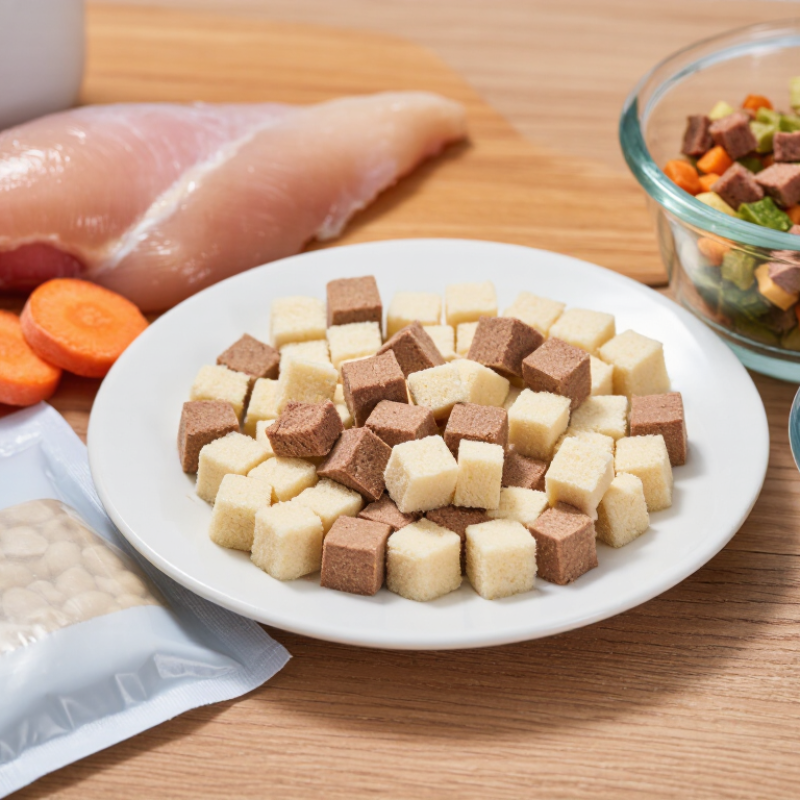
Define Freeze-Dried Raw Food Through AAFCO’s 2024 Nutrient Profiles
How to Source Freeze-Dried Raw Dog Food in 2026?
Define Freeze-Dried Raw Food Through AAFCO’s 2024 Nutrient Profiles
Freeze-dried raw food is a processing format, not a nutritional standard. AAFCO’s 2024 Dog Food Nutrient Profiles help define whether a formula supplies essential nutrients for dogs. They cover life stages, including growth, reproduction, and adult maintenance. The package should clearly identify its intended nutritional adequacy.
Look for a complete-and-balanced statement supported by the correct AAFCO profile. A product designed for puppies needs different nutrient targets than adult maintenance food. Calcium, phosphorus, copper, zinc, vitamin D, and amino acids deserve close attention. Small label details matter.
Ask the supplier for a current finished-product analysis. Check guaranteed analysis values against laboratory results, ingredient specifications, and serving instructions. A certificate of analysis can support confidence, but it should match the exact production lot. Generic documents are weaker evidence.
Raw ingredients also require careful handling. Ask how the supplier controls contamination risks before and after freeze-drying. Verify storage temperatures, packaging integrity, traceability, and shelf-life testing. Freeze-drying removes moisture, but it does not automatically make every product nutritionally complete or microbiologically risk-free.
AAFCO profiles are authoritative reference standards, not automatic government approval. Local feed rules may differ. I would also question vague claims such as “natural balance” or “ancestral nutrition.” They sound persuasive, yet they do not replace nutrient verification. One practical concern remains: some formulas appear complete on paper but provide unclear feeding directions. That gap deserves attention before purchase.
Compare Guaranteed Analysis Data for Protein, Fat, Moisture, and Calories
How to Source Freeze Dried Raw Dog Food in 2026?
When sourcing freeze dried raw dog food, begin with the guaranteed analysis panel. Protein and fat percentages are usually listed “as fed,” including the product’s remaining moisture. That number can mislead comparisons. A food with 35% protein and 8% moisture may provide more protein than one showing 40% protein with 15% moisture. Use this dry matter formula: nutrient percentage divided by 100 minus moisture, then multiplied by 100. It takes a minute. It matters.
Fat deserves equal attention. Higher fat can support active dogs, but it also raises calories quickly. Check the calorie statement in kilocalories per kilogram and per serving. Compare equal weights, not scoops, because pieces vary in density. Moisture levels also affect rehydration. A low-moisture product may need more water than expected, especially for older dogs with poor drinking habits. I prefer clear feeding directions, visible batch details, and recent laboratory testing information. Vague labels slow the decision.
Sourcing requires more than attractive numbers. Ask whether the supplier records ingredient origins, production dates, and storage conditions. Look for consistent analyses across batches, since natural ingredients can shift results. The guaranteed analysis is useful, not flawless. It may not reveal amino-acid quality, digestibility, or oxidation risk. I once focused too heavily on protein and overlooked calorie density. That was a practical mistake. Compare the panel with your dog’s age, activity, body condition, and veterinarian’s advice. Exact figures help, but context still decides suitability.
How to Source Freeze Dried Raw Dog Food in 2026? - Compare Guaranteed Analysis Data for Protein, Fat, Moisture, and Calories
| Nutritional Reference or Sourcing Benchmark | Crude Protein
Minimum or Range | Crude Fat
Minimum or Range | Moisture
Maximum or Range | Metabolizable Energy | Recommended Purchasing Check |
Adult maintenance reference
Minimum nutrient profile on a dry-matter basis | 18.0% minimum | 5.5% minimum | Not specified as a nutrient minimum | Must be declared or laboratory verified | Request the complete nutrient profile and confirm that the label basis is clearly identified as fed or dry matter. |
Growth and reproduction reference
Minimum nutrient profile on a dry-matter basis | 22.5% minimum | 8.5% minimum | Not specified as a nutrient minimum | Must support the declared feeding purpose | Use a separate review for puppies, pregnancy, and lactation; do not rely only on high protein or high fat values. |
Typical freeze-dried raw sourcing band
Practical screening range for supplier labels | 35%–55% as-fed | 15%–35% as-fed | 3%–8% as-fed | 3,500–5,500 kcal/kg | Treat these figures as screening bands rather than compliance standards; obtain a current certificate of analysis for each production lot. |
Lower-fat sourcing option
Useful for calorie-controlled adult feeding plans | 35%–45% as-fed | 15%–22% as-fed | 3%–8% as-fed | 3,500–4,500 kcal/kg | Compare calories per 100 g, not just crude fat percentage, because lower moisture increases nutrient concentration. |
Higher-energy sourcing option
Useful for active dogs or smaller feeding volumes | 40%–55% as-fed | 25%–35% as-fed | 3%–7% as-fed | 4,500–5,500 kcal/kg | Check portion instructions and calorie density carefully to reduce the risk of overfeeding. |
Dry-matter conversion example
For a label showing 40% protein, 20% fat, and 5% moisture | 42.1% dry matter | 21.1% dry matter | 95% dry matter | Use the declared kcal/kg value | Formula: dry-matter nutrient percentage = as-fed percentage ÷ (100 − moisture percentage) × 100. |
Supplier data checklist: Require the guaranteed analysis on an as-fed basis, moisture percentage, metabolizable energy in kcal/kg or kcal/100 g, complete ingredient declaration, feeding-purpose statement, lot number, production date, and a current certificate of analysis. Guaranteed analysis values are minimums or maximums, not exact laboratory averages.
Audit Certificates, Batch Testing, and 2026 Supply-Chain Costs
Sourcing freeze-dried raw dog food in 2026 requires evidence, not attractive packaging. Request current HACCP records, a third-party audit certificate, and the latest audit scope. A certificate alone proves little. Confirm the facility, product category, expiry date, and nonconformity history. FDA testing found Salmonella in 15 of 196 raw pet food samples and Listeria monocytogenes in 32 samples. That risk deserves practical controls.
Ask for batch-specific certificates of analysis, not generic laboratory templates. Each release should show Salmonella, Listeria, pathogenic E. coli, moisture, water activity, and oxidation results. Keep retained samples from every production lot. A sealed pouch, lot code, and laboratory report should match physically. Small errors happen. They still matter. Review laboratory accreditation and test methods carefully, because “tested” does not always mean independently verified.
Supply-chain costing is less visible. APPA reported US pet-industry spending of 150.6 billion dollars in 2024, increasing pressure on reliable supply and traceability. USDA Agricultural Marketing Service reports show continuing movement in meat and poultry input prices. For 2026 quotations, separate raw materials, freeze-drying energy, laboratory testing, compliant packaging, inland freight, insurance, and rejected-batch reserves. Add temperature-controlled storage where needed. Do not hide these costs inside one blended price. A low factory quote may simply exclude testing, rework, or port delays. Review quarterly, not annually.