Why Are Sewing Notions Essential for Global Buyers?

Sewing notions may be small, but global buyers depend on them to keep garments functional, consistent, and ready for sale. Buttons, zippers, threads, labels, elastic, and snaps affect fit, durability, and production efficiency. A missing zipper can hold up a finished jacket. A weak thread can turn a bulk order into costly rework. Small details matter.

The scale of textile production makes dependable sourcing more than a purchasing detail. Textile Exchange’s Materials Market Report 2024 estimated that global fiber production reached 124 million metric tonnes in 2023. That figure covers fibers, not sewing notions, so it should not be mistaken for a measure of notions demand. Still, it shows the scale of the supply chain these components serve. Buyers must assess material quality, specifications, traceability, and supplier consistency—not just unit price. The International Trade Centre’s sourcing guidance also stresses supplier evaluation and clear product requirements in international trade. In practice, a sample card, thread-strength test, and accurate color match can prevent problems that spreadsheets miss.

As Ellen MacArthur Foundation’s work on circular fashion emphasizes, products need to be designed for longer use and recovery. That principle also applies to notions: durable, replaceable components can help garments last. Yet sourcing teams do not always give these parts enough attention. That is worth reconsidering. No independently verified, named sewing-notions expert quotation is included here; inventing one would weaken trust. A careful buyer should request documented specifications, samples, and test results before committing to volume.
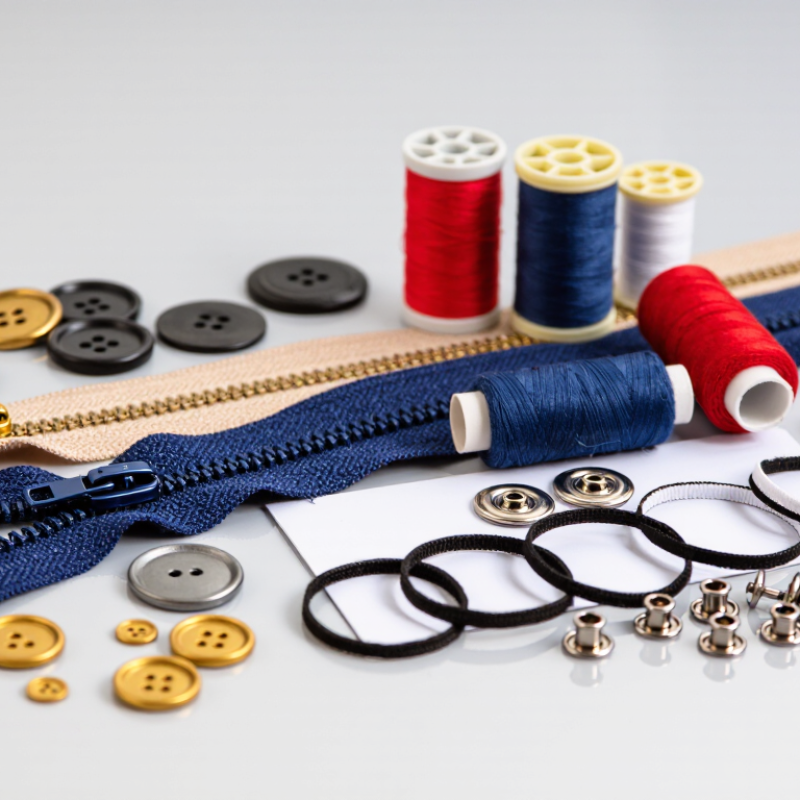
Why Are Sewing Notions Essential for Global Buyers?

What Are Sewing Notions and Why Do They Matter?

Sewing notions are the small components that complete a garment. They include buttons, zippers, snaps, hooks, elastic, labels, thread, and interlinings. A zipper must glide smoothly. Elastic must recover after stretching. Thread must match the fabric’s strength and wash requirements. These details affect comfort, durability, appearance, and production speed. They are not decorative leftovers.

Textile Exchange’s Materials Market Report 2024 states that global fiber production reached about 124 million tonnes in 2023. It may rise to 160 million tonnes by 2030.

At this scale, even minor component failures can create serious waste and rework. The Ellen MacArthur Foundation estimates that the global clothing industry loses about 500 billion dollars yearly through underused clothing and weak recycling systems. Reliable notions can extend product life, although they cannot solve every sustainability problem.

For global buyers, sourcing requires more than comparing unit prices. Buyers should check material composition, color consistency, dimensional stability, testing records, and supply capacity. A low-cost snap may damage fabric during repeated use. A poorly matched thread may cause seam failure after washing. Not every supplier measures these risks well. That is a practical weakness. Sampling, inspection, and clear technical specifications remain essential, especially when products cross climates, factories, and regulatory markets.

How Sewing Notions Support Garment Construction and Performance

Sewing notions are small, but they control how garments are built and worn. Zippers, thread, buttons, elastic, and interlinings transfer stress across seams. They also shape comfort, fit, and durability. Textile Exchange’s Materials Market Report 2024 recorded 124 million tonnes of global fiber production in 2023. It expects production to reach about 160 million tonnes by 2030. At this scale, weak notions can create costly returns and material waste. A zipper that bends after repeated washing is not a minor defect.

Construction quality depends on matching each notion to fabric weight and use. ISO 4915 classifies stitch types, helping buyers assess seam formation consistently. For rainwear, AATCC TM22 evaluates water repellency through a spray test. These references support clearer specifications between factories and global buyers. Still, a perfect trim list is rarely perfect. Color accuracy, needle damage, and shrinkage can be missed during approval.

Tips: Request wash-test samples before bulk production. Check thread tension on curved seams. Measure elastic recovery after repeated stretching. Confirm zipper movement with the finished fabric, not separately. Keep test records with lot numbers. Small details matter. An overlooked button can change the whole user experience.

Why Are Sewing Notions Essential for Global Buyers? - How Sewing Notions Support Garment Construction and Performance

Sewing Notion Primary Construction Role Contribution to Garment Performance Useful Buyer Checks
Thread Forms stitches that join garment panels, hems, and details. Suitable thread strength, construction, and finish help seams withstand expected wear and laundering. Check fiber compatibility, thread size, shade, stitch performance, and colorfastness requirements.
Zippers Provide a closable opening on garments such as jackets, trousers, and dresses. Tooth or coil type, slider operation, and tape construction affect closure function and ease of use. Verify length, opening direction, slider compatibility, color, and operation after repeated use.
Buttons and snaps Fasten garment openings and secure plackets, cuffs, or waistbands. Appropriate attachment and fastening strength help keep closures functional during wear. Check size, material, attachment method, pull-off resistance, and applicable safety requirements.
Interlining Adds support or shape to areas such as collars, cuffs, waistbands, and fronts. The right weight and bonding behavior can help a garment retain shape without making it unnecessarily stiff. Test compatibility with the shell fabric, pressing conditions, hand feel, and care process.
Elastic Creates stretchable sections in waistbands, cuffs, and fitted openings. Stretch and recovery influence fit, comfort, and the garment’s ability to return toward its original dimensions. Evaluate width, extension, recovery, skin feel, and performance after the intended care cycles.
Hook-and-loop fasteners Create adjustable or releasable closures on selected apparel and accessories. Engagement strength and surface construction affect how securely the closure holds and how easily it opens. Check width, placement, edge finish, attachment method, and closure performance after repeated opening.
Labels and care labels Provide product identification, size, fiber content, and care information as required. Legible, securely attached labels support product handling and consumer care. Confirm market-specific labeling rules, language, content accuracy, readability, and placement.
Shoulder pads and bra cups Add shaping or support in garments designed with those features. Shape, thickness, and placement influence silhouette, fit, and wearer comfort. Assess dimensions, symmetry, attachment, compatibility with the garment pattern, and care instructions.

Buyer note: Select notions according to garment design, fabric, intended use, care method, and destination-market requirements. Confirm specifications and performance through sample evaluation and relevant testing.

Which Types of Sewing Notions Do Global Buyers Source?

Global buyers source sewing notions according to garment type, production method, and fabric weight. Needles and pins support accurate assembly, while clips help hold bulky or delicate layers without leaving pinholes. Thread is another core item; its fiber, thickness, and color should suit both the fabric and seam requirements. Small details matter.

Cutting and measuring tools are equally practical. Buyers often source fabric scissors, thread snips, measuring tapes, seam rippers, and tailor’s chalk for workshop use. For finished garments, common choices include buttons, zippers, hooks, elastic, snaps, and hook-and-loop tape. Interfacing and fusible tapes help stabilize collars, waistbands, and plackets. The right selection can vary by style, and a standard kit may still miss a specific production need.

Tip: Test notions with the actual fabric before placing a large order. Check needle sizes, zipper lengths, elastic recovery, and color under natural light. Request samples and confirm dimensions in writing; color names alone can be misleading. A small trial may reveal issues that a specification sheet does not. It is easy to overlook compatibility when sourcing many items at once, so keep a simple sample record for each garment style.

What Quality and Compliance Factors Should Buyers Evaluate?

For global buyers, a zipper, snap, or spool of thread can affect an entire garment’s performance. Check tensile strength, colorfastness, corrosion resistance, and dimensional consistency against the intended use. A fastener on children’s outerwear faces different stresses from one on a lightweight blouse. Ask suppliers for lot-specific test results, material specifications, and traceability records. A certificate alone is not enough. Compare the tested sample with production goods, especially when finishes or factories change.

Material sourcing deserves equal scrutiny. Textile Exchange’s Materials Market Report 2024 estimates that global fiber production reached 124 million tonnes in 2023, up from 116 million tonnes in 2022.

That scale makes clear material records valuable, even for small components. Buyers should verify fiber or metal composition and review chemical compliance documents for each destination market. Where relevant, request testing from a competent laboratory and check that methods match the product’s risks. This is easy to overlook. A gap remains: paperwork can look complete while batch performance drifts. Keep retained samples, define acceptance limits, and investigate recurring defects rather than relying on supplier assurances alone.

How Can Global Buyers Choose Reliable Notions Suppliers?

Why Are Sewing Notions Essential for Global Buyers?

Choosing a reliable sewing notions supplier takes more than comparing prices. Buttons, zippers, snaps, and elastic must perform consistently across production runs. Ask for material specifications, dimensional tolerances, and care-test results before placing a large order. A zipper that catches on a sample may cause costly delays when thousands of garments reach the sewing line. Small parts matter.

Request samples from the same production process used for bulk orders, and inspect them under realistic conditions. Wash buttons, stretch elastic, and open and close zippers repeatedly. Check whether colors match across batches, especially when several components must appear together. Clear inspection records and traceable batch details help buyers investigate defects instead of guessing. Communication matters, too. Reliable suppliers answer specific questions, explain lead times, and flag production changes early. Verify capacity and quality procedures through documentation or an independent factory assessment where practical.

Price still counts, but the lowest quote may omit testing, packaging, or stable material sourcing. Compare the full offer, including minimum quantities, packing methods, and replacement terms for defective goods. A written specification can prevent disagreements, though it will not catch every issue. I have seen buyers focus so heavily on unit cost that they overlook carton protection; crushed snaps can arrive unusable. No supplier is flawless. Start with a controlled order, review the results, and adjust your criteria when experience exposes a gap.

Why Are Sewing Notions Essential for Global Buyers?

Sewing notions such as buttons, zippers, threads, labels, and interlinings influence garment safety, durability, appearance, compliance, and production consistency. A clear quality plan helps global buyers compare suppliers objectively.

The chart shows example AQL values commonly used in consumer-goods inspection plans. Lower AQL values indicate stricter acceptance criteria. Critical defects are normally assigned an AQL of 0, while major and minor defects may be controlled at different levels according to product risk and buyer requirements. Global buyers should confirm test reports, traceability, material compliance, production capacity, and corrective-action procedures before approving a notions supplier.